What are the five barriers to effective listening?
 Mia Lopez
 - Top 5 Barriers to Effective Listening at a workplace.
- #1 Distraction and being preoccupied. #1.1 Mobile phones and other smart devices. #1.2 Emotions.
- #2 Noisy environment.
- #3 Mindset and Personal Perspectives.
- #4 Interruptions.
- #5 Physical state. Conclusion.
.
Herein, what are the barriers for effective listening?
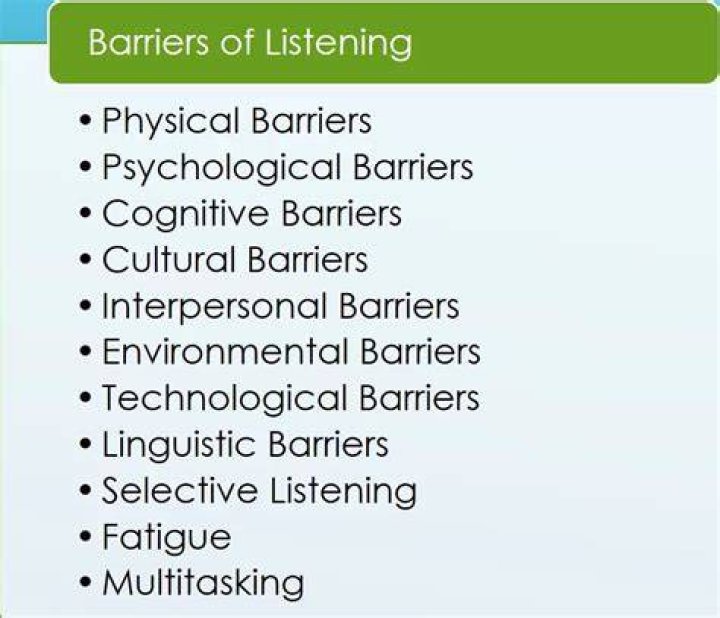
Environmental and physical barriers to effective listening include furniture placement, environmental noise such as sounds of traffic or people talking, physiological noise such as a sinus headache or hunger, and psychological noise such as stress or anger.
Additionally, what are the difficulties in listening? According to Goh (1999) the most common problems faced by students in listening in the order of frequency are quickly forgetting what is heard , not recognising the words they know, understanding the message but not the intended message, neglecting next part while thinking about meaning, unabling to form a mental
In this way, what are 5 barriers to effective communication?
There are five key barriers that can occur within a company: language, cultural diversity, gender differences, status differences and physical separation. These barriers to communication are specific items that can distort or prevent communication within an organization.
What is listening and its barriers?
Environmental and physical barriers to effective listening include furniture placement, environmental noise such as sounds of traffic or people talking, physiological noise such as a sinus headache or hunger, and psychological noise such as stress or anger.
Related Question Answers
What do you mean by barriers?
A barrier is a problem that prevents two people or groups from agreeing, communicating, or working with each other. A barrier is something such as a fence or wall that is put in place to prevent people from moving easily from one area to another. The demonstrators broke through heavy police barriers.What is the importance of listening?
Good listening allows us to demonstrate that we are paying attention to the thoughts, feelings and behaviours of the other person (seeing the world through their eyes). This is crucial to maintaining productive relationships, and sometimes the only way to establish communication.What are the 7 barriers to effective communication?
Barriers to Effective Communication- Physical Barriers. Physical barriers in the workplace include:
- Perceptual Barriers. It can be hard to work out how to improve your communication skills.
- Emotional Barriers.
- Cultural Barriers.
- Language Barriers.
- Gender Barriers.
- Interpersonal Barriers.
- Withdrawal.
What is the purpose of listening?
The purpose of listening is to gain information that becomes the basis for taking a decision on any topic. A student who attends to his teacher and listens to him attentively learns a lot. A customer listens to a seller attentively and gets information about a product.How can we avoid listening barriers?
Try these tips to overcome this habit:- Think before you speak, and don't speak if you have nothing important to contribute.
- Practice self-control.
- Avoid interrupting when the other person is speaking.
- Be aware of indulging in useless talk for the sake of talking.
- Be brief while conveying your thoughts.
Why empathic listening is important?
When you listen to understand, you pay attention to the thoughts and feelings of the person speaking. Empathetic listening gives us the tools to see a problem, understand the effect it is having, and find a solution. In order to help someone, we must first understand the problem from his or her point of view.What is an effective listener?
Definition. Effective listening skills are the ability to actively understand information provided by the speaker, and display interest in the topic discussed. It can also include providing the speaker with feedback, such as the asking of pertinent questions; so the speaker knows the message is being understood.What are the major barriers to effective communication?
There are five key barriers that can occur within a company: language, cultural diversity, gender differences, status differences and physical separation. These barriers to communication are specific items that can distort or prevent communication within an organization.What are the 10 barriers of communication?
10 BARRIERS TO EFFECTIVE COMMUNICATION AND PERSUASION- Physical and physiological barriers.
- Emotional and cultural noise.
- Language.
- Nothing or little in common.
- Lack of eye contact.
- Information overload and lack of focus.
- Not being prepared, lack of credibility.
- Talking too much.
What are the 7 C's of communication?
What are the 7 C's of Communication?- Completeness. The message must be complete and geared to the receiver's perception of the world.
- Concreteness. Concrete business communication is also about a clear message.
- Courtesy.
- Correctness.
- Clarity.
- Consideration.
- Conciseness.
- Creativity.
What is emotional barrier?
Emotional barriers are mental walls that keep you from openly communicating your thoughts and feelings to others. They prevent you from being yourself and living your life to the fullest. Individuals with emotional barriers tend to be extremely reserved, cautious, and insecure.What are the 6 barriers to effective communication?
Besides physical and technical barriers, there are six barriers to effective communication every employee and manager should strive to eradicate.- Dissatisfaction or Disinterest With One's Job.
- Inability to Listen to Others.
- Lack of Transparency & Trust.
- Communication Styles (when they differ)
- Conflicts in the Workplace.
What are personal barriers?
Definition: The Personal Barriers relate to the factors that are personal to the sender and receiver and act as a hindrance in the communication process. These factors include the life experiences, emotions, attitudes, behavior that hinders the ability of a person to communicate.What is an effective communication?
Effective communication is defined as verbal speech or other methods of relaying information that get a point across. An example of effective communication is when the person who you are talking to listens actively, absorbs your point and understands it.How does the environment affect communication?
Environmental contexts can have negative and/or positive effects on interpersonal communication or produce barriers, things that inhibit effective communication. So things like location, temperature, weather or time of day affect communication and present different barriers for effective communication.What are the types of barriers?
Types of Barriers to Communication – Technical, Language and Psychological Barriers- Technical Barriers:
- Language Barriers:
- Psychological Barriers:
- External Barriers:
- Organizational Barriers:
- Personal Barriers:
- Type # 1. Organisational Barrier:
- Type # 2. Status Barrier:
What can we do to improve listening skills?
Here are 10 tips to help you develop effective listening skills.- Step 1: Face the speaker and maintain eye contact.
- Step 2: Be attentive, but relaxed.
- Step 3: Keep an open mind.
- Step 4: Listen to the words and try to picture what the speaker is saying.
- Step 5: Don't interrupt and don't impose your "solutions."
Why is listening difficult for students?
Students have critical difficulties in listening comprehension because universities and schools pay more attention to writing, reading, and vocabulary. Listening is not an important part of many course books and most teachers do not pay attention to this important skill in their classes.What are the factors that affect listening effectiveness?
I'd love to hear other factors that affect your ability to listen effectively also in the comment box below.- Lack of interest. Often times, we get ourselves caught in a conversation that essentially does not hold our interest.
- Noise, Awkward seating positions and temperature.
- Distractions.
- Personal bias.
- Intrusion.