What are the functions of the primary dentition?
 Matthew Perez
 .
Likewise, people ask, what is the primary dentition?
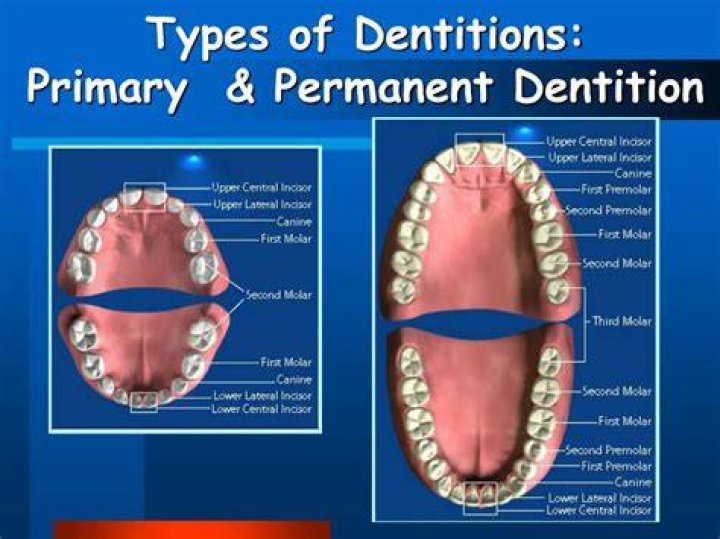
Primary Dentition. These are the first teeth to erupt into the oral cavity. The primary dentition is comprised of 20 teeth. Often these teeth are referred to as deciduous teeth. In each arch of the mouth, there are two central incisors, two lateral incisors, two canines, and four molars.
Also, what are the primary teeth numbers? For primary teeth, the sequence of numbers goes 5, 6, 7, and 8 for the teeth in the upper right, upper left, lower left, and lower right respectively. When speaking about a certain tooth such as the permanent maxillary central incisor, the notation is pronounced “one, one”.
Correspondingly, what are the types of teeth and their functions?
The Four Types of Teeth and Their Functions in Your Mouth
- Incisors - Your incisors are eight teeth in the front center of your mouth (four on both bottom and top).
- Canines - Your canines are the next teeth that develop in your mouth.
- Premolars - Premolars are used for tearing and crushing food.
- Molars - Your molars are your largest teeth.
What is another name for primary dentition?
FMA. 75151. Anatomical terminology. Deciduous teeth – commonly known as baby teeth, milk teeth, temporary teeth, and primary teeth – are the first set of teeth in the growth development of humans and other diphyodont mammals.
Related Question Answers
What is the difference between primary and permanent dentition?
Differences between primary and permanent teeth include: primary teeth have thinner layers of enamel and dentin. the roots of front primary teeth are narrower. Compared to their crowns, primary tooth roots are Longer and more slender.What are the two types of dentition?
Types of Teeth and Their Functions- Incisors – The four front teeth in both the upper and lower jaws are called incisors.
- Canines – There are four canines in the oral cavity.
- Premolars (Bicuspids) – These teeth are located behind and adjacent to the canines and are designed to crush food.
- Molars – The most posterior teeth in the mouth are the molars.
How many premolars are in the primary dentition?
The primary teeth begin to erupt at 6 months of age. The permanent dentition is composed of 32 teeth with 16 in each arch. There are eight teeth in each quadrant, composed of two incisors (central and lateral), a canine, two premolars, and three molars.What is the human dentition?
Dentition pertains to the development of teeth and their arrangement in the mouth. In particular, it is the characteristic arrangement, kind, and number of teeth in a given species at a given age.Are premolars Succedaneous?
Third molars, 17 years. The permanent incisors, canines, and premolars are called succedaneous teeth because they replace (succeed) the primary teeth.What are the types of dentition?
While different numbers abound, it's generally accepted that we have three different types of teeth: Incisors, canines, and molars.What does permanent dentition mean?
The permanent dentition is comprised of 32 teeth. The permanent central incisors, lateral incisors, first and second premolars replace the primary dentition. The primary molars are replaced with the permanent premolars, and the permanent molars erupt posterior to those.What is the function of premolars?
The premolars, unlike the incisors and canines, have a flat biting surface. Their function is to tear and crush food. They are unique to the permanent dentition which has eight premolars.What are teeth called?
Incisors — the sharp, chisel-shaped front teeth (four upper, four lower) used for cutting food. Canines — sometimes called cuspids, these teeth are shaped like points (cusps) and are used for tearing food. Premolars — these teeth have two pointed cusps on their biting surface and are sometimes referred to as bicuspids.What are premolars used for?
Premolars Premolars, or bicuspids, are used for chewing and grinding food. Adults have four premolars on each side of their mouths — two on the upper and two on the lower jaw. There are no primary premolars; the first premolars appear around age 10, with the second premolars arriving about a year later.What are human canines for?
Humans have sharp front teeth called canines, just like lions, hippos, and other mammals. Contrary to popular belief, human canines are not for tearing and ripping meat. Instead, our ancestors used them to fight male rivals for mating rights.What is dentition formula?
The dental formula represents the arrangement of teeth in each half of the upper and the lower jaw. The entire formula is multiplied by two to represent the total number of teeth. Each half of the upper jaw and the lower jaw has 2 incisors, 1 canine, 2 premolars, and 3 molars.How many type of teeth do we have?
We have different types of deciduous teeth: incisors, canines,first molars, and second molars. Each tooth has four types of surfaces. They are the inner surface, outer surface,chewing surface and adjacent surface.What are premolars?
Just as their name indicates, premolars are located just before the molars in the human mouth. These teeth are also known as bicuspids. The premolars are considered transitional teeth, as they work to guide food from the cuspids near the front of the mouth back to the molars near the rear of the mouth for chewing.Are teeth bones?
Teeth consist mostly of hard, inorganic minerals like calcium. They also contain nerves, blood vessels and specialized cells. But they are not bones. Teeth don't have the regenerative powers that bones do and can't grow back together if broken.What are teeth made of?
Human teeth are made up of four different types of tissue: pulp, dentin, enamel, and cementum. The pulp is the innermost portion of the tooth and consists of connective tissue , nerves, and blood vessels, which nourish the tooth.What are the 20 primary teeth?
A child's mouth contains 20 initial teeth, called primary teeth, baby teeth, or deciduous teeth, consisting of the following teeth types:- 4 second molars.
- 4 first molars.
- 4 cuspids (also called canine or eye teeth)
- 4 lateral incisors.
- 4 central incisors.